
时间:2009-04-25 09:58
人气:
作者:admin
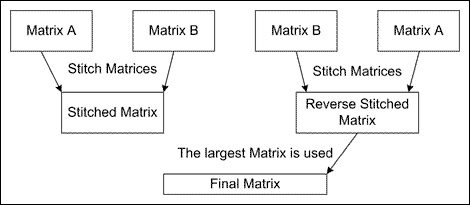
| Stitch Technique | Size of Final Data Set | Description | ||||
| Data Set Numbers | # of codes (averaged) |
% of two data sets (averaged) | ||||
| 1 + 2 | 3 + 4 | 1 + 4 | ||||
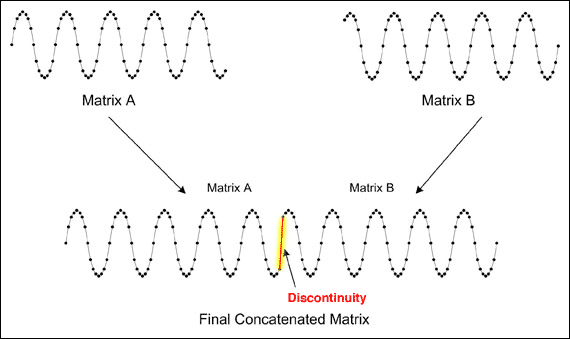
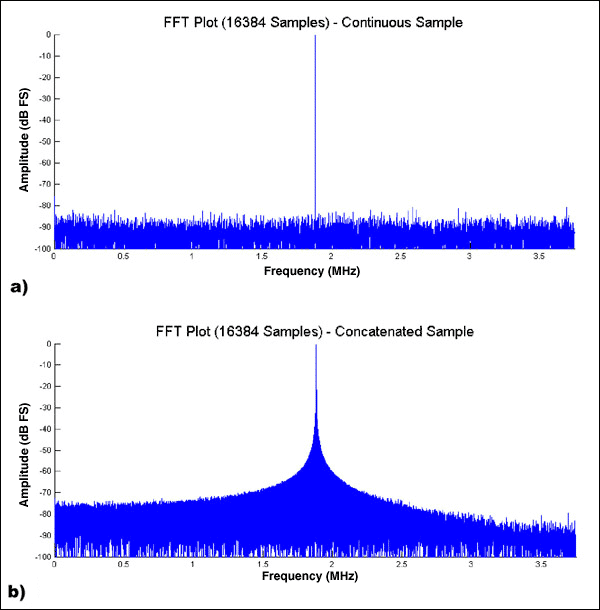
| Concatenate† | N/A | 16384 | 100% | Will produce erroneous FFT; however, INL/DNL can be extracted from this data. | ||
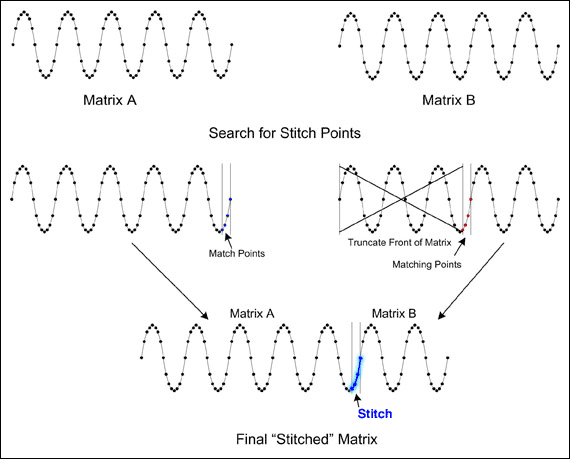
| Basic | 11060 | 8192‡ | 14384 | 11212 | 68.4% | FFT is useable for calculating figures of merit. |
| Reverse | 11060 | 8192‡ | 14384 | 11212 | 68.4% | |
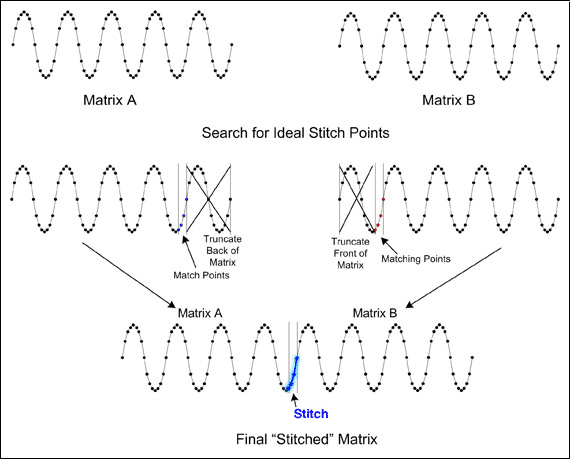
| Advanced | 13790 | 16046 | 16022 | 15286 | 93.3% | |
| Advanced + Reverse |
15427 | 16176 | 16022 | 15875 | 96.9% | |
function [StitchedMatrix, StitchBins] = StitchMatrices(MatrixA, ...
   				MatrixB, StitchNumber, PrevStitchBins, ...
				AdvCodeStitchEnabled, ReverseStitchEnabled);
%Stitch Matrices Function
%Revision 1.0
%
%By Donald Schelle, May 2005
%Maxim Integrated Products
%120 San Gabriel Drive
%Sunnyvale, CA, 94086
%
%This function will take two matrices (MatrixA and MatrixB), find a
%given number (StitchNumber) of identical points in each and
%concatenate the two matrices into one.
%
%Inputs = MatrixA, MatrixB (Data Matrices)
%		    StitchNumber (Number of points to match)
%			 PrevStitchBins (Bins of Previous Stitches in MatrixA)
%			 AdvStitchEnabled (0 = NO, 1 = YES)
%			 ReverseStitchEnabled (0 = NO, 1 = YES)
%Output = StitchedMatrix (MatrixA + MatrixB)
%			 StitchBins (bins of StitchedMatrix where the two
%						    matrices were joined.)
%
%If the matrices can not be joined the function will output a NaN
%for both the StitchedMatrix variable and the StitchBins variable
%--------------------------------------------------------------------------

%Check to see that there are at least TWO StitchNumber Points
if StitchNumber < 2,
   %Requested less than 2 stitch points
   StitchedMatrix = NaN;
   StitchBins = NaN;
   return;
end;

%Calculate Size of MatrixA and MatrixB
[SizeA, Junk] = size(MatrixA);
[SizeB, Junk] = size(MatrixB);

%Find the Stitch Points in MatrixB
[NormalA, NormalB] = FindStitchPoint(MatrixA, MatrixB, ...
   					StitchNumber, AdvCodeStitchEnabled);
%Calculate the size of the NormalStitched Matrix
NormalStitchedSize = NormalA + SizeB - NormalB + 1;

%Check to see if the reverse function is enabled
if ReverseStitchEnabled == 1,
   %Find Stitch Points for Reverse Matrices
   [ReverseB, ReverseA] = FindStitchPoint(MatrixB, MatrixA, ...
      					StitchNumber, AdvCodeStitchEnabled);
   %Calculate the size of the Revered Stitched Matrix
   ReverseStitchedSize = ReverseB + SizeA - ReverseA + 1;
else
   %Set Values to defaults
   ReverseStitchedSize = NaN;		%MatrixB/A Stitch Size
   ReverseA = NaN;
   ReverseB = NaN;
end;

%Check to if it's possible to stitch two matrices
if isnan(NormalStitchedSize) & isnan(ReverseStitchedSize) == 1,
   %The two matrices could not be stitched
   StitchedMatrix = NaN;
   StitchBins = NaN;
   return;
end;

%--------------------- Normal Matrix Stitching Routine ---------------
if (NormalStitchedSize >= ReverseStitchedSize)| ...
   			isnan(ReverseStitchedSize) == 1,
   %Stitch MatrixB to the end of MatrixA
   StitchedMatrix = cat(1, MatrixA(1:NormalA), MatrixB(NormalB:SizeB));

   %Update Stitch Bins
   if isnan(PrevStitchBins) == 1,
      %There are no previous stitch bins
      StitchBins = [NormalA, NormalA + StitchNumber - 1];
   else
      %There are previous stitch bins
      %Check for Snipped Stitches
      [SizeStitchBins, Junk] = size(PrevStitchBins);

      while (PrevStitchBins(SizeStitchBins, 2) > (NormalA - 1)),
         %Second Bin is snipped from matrix. Check if first bin is snipped.
         if (PrevStitchBins(SizeStitchBins, 1) > (NormalA - 1)),
            %First Bin is snipped too. Delete Bin Pair
            PrevStitchBins = PrevStitchBins(1:(SizeStitchBins-1),:);
         else
            %First Bin is not snipped but second bin is snipped
            %Shrink Stitch Size
            PrevStitchBins(SizeStitchBins, 2) = NormalA - 1;
         end;

         %Calculate size of new PrevStitchBin Matrix
         [SizeStitchBins, Junk] = size(PrevStitchBins);
      end;

      %Insert New StitchBins
      [SizeStitchBins, Junk] = size(PrevStitchBins);
      StitchBins = PrevStitchBins;
      StitchBins(SizeStitchBins + 1, :) = ...
      [NormalA, NormalA + StitchNumber - 1];

      %Check to see if the last two stitches need to be combined
      [SizeStitchBins, Junk] = size(StitchBins);
      if StitchBins(SizeStitchBins,1) == ...
            (StitchBins((SizeStitchBins - 1),2) + 1),
         %Combine Stitches
         StitchBins((SizeStitchBins - 1),2) = StitchBins((SizeStitchBins),2);
         %Shorten StitchBin Matrix
         StitchBins = StitchBins(1:(SizeStitchBins - 1),:);
      end;

   end;
end;


%--------------------- Reverse Matrix Stitching Routine ---------------
if (ReverseStitchedSize >= NormalStitchedSize)| ...
   			isnan(NormalStitchedSize) == 1,
   %Stitch MatrixA to the end of MatrixB
   StitchedMatrix = cat(1,MatrixB(1:ReverseB), MatrixA(ReverseA:SizeA));

   %Update Stitch Bins
   if isnan(PrevStitchBins) == 1,
      %There are no previous stitch bins
      StitchBins = [ReverseB, ReverseB + StitchNumber - 1];
   else
      %There are previous stitch bins
      %Check for Snipped Stitches
      while (PrevStitchBins(1,1) < (ReverseA + StitchNumber - 1)),
         %First Bin is snipped from matrix. Check if second is snipped
         if (PrevStitchBins(1,2) < (ReverseA + StitchNumber - 1)),
            %Second Bin is snipped too. Delete Bad Pair
            [SizeStitchBins, Junk] = size(PrevStitchBins);
      	     PrevStitchBins = PrevStitchBins(2:SizeStitchBins, :);
         else
            %Second Bin is not snipped, but first bin is snipped
            %Shrink Old Stitch Size
            PrevStitchBins(1,1) = ReverseA + StitchNumber - 1;
         end;
      end;

      %Offset Stitch Bins by inserted amount
      StitchBins = PrevStitchBins + ReverseB - ReverseA + 1;
      %Make Room for new StitchBins
      [SizeStitchBins, Junk] = size(PrevStitchBins);
      StitchBins(2:SizeStitchBins+1, :) = StitchBins;
      %Insert New Stitch Bins
      StitchBins(1,:) = [ReverseB, ReverseB + StitchNumber - 1];

      %Combine close stitches
      if StitchBins(1,2) == StitchBins(2,1) - 1,
         %Combine Stitches
         StitchBins(2,1) = StitchBins(1,1);
         %Shrink Stitch Bins Matrix
	 [SizeStitchBins, Junk] = size(StitchBins);
         StitchBins = StitchBins(2:SizeStitchBins,:);
      end;

   end;
end;
附录B:FindStitchPoint例程(FindStitchPoint.m)function [OutputBinA, OutputBinB]=FindStitchPoint(MatrixA, MatrixB, ...
MatchNumber, AdvancedStitchFindEnabled)
%Find Stitch Points Function
%Revision 1.0
%
%By Donald Schelle, May 2005
%Maxim Integrated Products
%120 San Gabriel Drive
%Sunnyvale, CA, 94086
%
%This function will find the IDEAL stitch point in Matrix B given
%the number of data points to match
%
%Inputs = MatrixA
% MatrixB
% Number of Records to Match
% Advanced Stitch Find Enabled (0 = NO, 1 = YES)
%Output = (OutputBinA) End Bin of MatrixA to stitch data
% (OutputBinB) Start Bin of Matrix B to stitch data
%
%If no bins are found, the function will output a NaN
%--------------------------------------------------------------------------
%Do argument error checking to see if there is enough arguments
if nargin < 2,
%The user has not supplied enough arguments
disp('Function requires TWO Matrices');
OutputBinA = NaN;
OutputBinB = NaN;
return;
elseif nargin < 3,
disp('Select a number of points to match');
OutputBinA = NaN;
OutputBinB = NaN;
return;
elseif nargin == 3,
%Advanced code stitching is NOT enabled
OutputBinA = NaN;
AdvancedStitchFindEnabled=0;
end;
%Ensure that Matrix A and B are single ROW matrices
[row col] = size(MatrixA);
if row > col, MatrixA = MatrixA'; end;
[row col] = size(MatrixB);
if row > col, MatrixB = MatrixB'; end;
%Determine Size of Matrices
[Junk, SizeA] = size(MatrixA);
[Junk, SizeB] = size(MatrixB);
%Initialize OutputBinB to NaN (which means that NO stitch points are found)
OutputBinB = NaN;
%Set initial size of BinA
BinA = SizeA - MatchNumber + 1;
%Initialize BinStop Variable
BinStop = SizeA-100;
%Loop to search through Matrix B numerous times. This loop is only
%excuted once if Advanced Stitch Find is disabled. The loop will stop when
%the 'ideal' stitch point is found
while BinA > BinStop,
%Stuff the Match Numbers into a separate Matrix
MatchMatrix = MatrixA(BinA:BinA+MatchNumber - 1);
%Find all bins in MatrixB that match the first number of the Match Matrix
MatchedBins = find(MatrixB == MatchMatrix(1));
%Compare the 2nd through nth number of the Match Matrix with the
%prospective series of numbers in MatrixB
%Calculate the size of the Matched Bins Matrix
[Junk, SizeMatchedBins] = size(MatchedBins);
%The advanced stitch mode optimizes search time by eliminating
%bad stitch points that would result in the final concatenated
%matrix being smaller than the last set of stitch points
if isnan(OutputBinB) == 0,
%A Stitch Point exists from a previous run. Elimiate bad stitch points
%Calculate critical Stitch Point
MatrixSize = OutputBinA + (SizeB-OutputBinB) + 1;
CriticalBin = BinA + SizeB - MatrixSize - 1;
%Find maximum number in the MatchMatrix
BadBin = find(MatchedBins > CriticalBin);
%Eliminate Bad Bins (if there are any)
if isempty(BadBin) == 0,
MatchedBins = MatchedBins(1:BadBin(1) - 1);
end;
%Calculate size of new Matched Bins Matrix
[Junk, SizeMatchedBins] = size(MatchedBins);
end;
%loop to cycle through initial matched bins
for i=1:SizeMatchedBins,
%Check to make sure that there isn't a MatrixB overrun
if (MatchedBins(i) + MatchNumber - 1) > SizeB,
break;
end;
%Assume that next few codes will match and set StitchBinGood = true
StitchBinGood = 1;
%Initialize MatchMatrixCounter
Count = 1;
%Cycle through MatrixB and compare Numbers with the MatchMatrix
for j=MatchedBins(i):(MatchedBins(i) + MatchNumber - 1),
if MatchMatrix(Count)==MatrixB(j),
%Number is good, continue and check next number
Count = Count + 1;
else
%Number is bad, break loop and try next sequence
StitchBinGood = 0;
break;
end;
end;
if StitchBinGood == 1,
%The optimal (first) stitch has been found
%Record the End bin of MatrixA
%Record the Start bin of MatrixB
OutputBinA = BinA;
OutputBinB = MatchedBins(i) + 1;
%Calculate the size of the joined Matrix and a new BinStop#
BinStop = OutputBinA-OutputBinB+1;
break;
end;
end;
if AdvancedStitchFindEnabled == 1,
%Advanced Stitch Find is enabled and we should make a new match
%matrix and search for these numbers
BinA = BinA - 1;
else
%Advanced Stitch Find is disabled and we should end the loop
break;
end;
end;
%Check to see if NO Bins Matched
if isnan(OutputBinB) == 1,
%NO Bins matched
OutputBinA = NaN;
end;
上一篇:混叠频率计算器


 关注微信
关注微信