Abstract:
Analog switches
can be used to enable the transmission of digital signals and power over the same two wires. The signal wavef
orm is rec
tified at the remo
te location to provide a stable supply voltage and modest lo
ad current (about 1mA
maximum) for the receiver.
This signaling system enables the transmission of digital signals and power over the same two wires (Figure 1). The signal waveform is rectified at the remote location to provide a stable supply voltage and modest load current (about 1mA maximum) for the receiver.
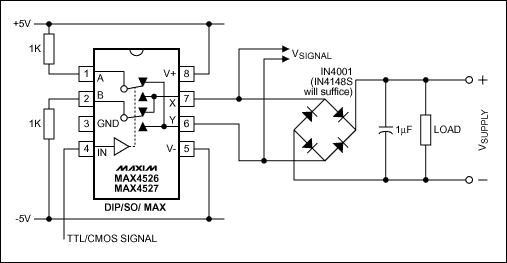
Figure 1. This digital signaling system
accepts single-ended data, transmits differential data, and produces a supply voltage for the receiver by full-wave rectifying the remote-end signal.
For conventional single-ended data, a series of "0s" can allow excessive droop in the receiver's supply voltage. To avoid that problem differential data (±5V to ±18V) is transmitted, pseudo
RS-485 style, from a single-ended
logic-level input. The full-wave rectifier and differential drive ensures that a supply voltage is always present
Current-limiting resistors at the supply inputs prevent damage in the event of a line short. Values of 1kΩ are optimum. Higher values produce excessive switching noise at the chip side of the resistors, caused by charge injection from the switches. Adequate decoupling of the supply rails also helps to minimize noise.
With +5V and -5V supplies powering the MAX4526/4527 as shown in Figure 1, the measured output for various loads is as follows:
|
Load (Ω) |
VSUPPLY(V) |
|
1M |
9.60 |
|
47k |
9.00 |
|
10k |
8.60 |
|
8.2k |
8.40 |
|
5k |
8.20 |



 关注微信
关注微信