要:本应用笔记说明了如何计算DS31256 HDLC
控制器的总线带宽。并展示了一个实验室实测的结果。同时演示了一个总线利用率速算表,该速算表如果需要可以索要。
概述
DS31256 HDLC控制器通过PCI总线存取发送和收到的HDLC包。本应用笔记讨论如何计算DS31256正常工作所需的总线带宽。所涉及到的相关术语的定义在本文的开始部分给出。
根据本应用笔记所提供的
信息,用户只需适当调整速算表(备索)中的一些数据,就可将它用于特定的应用中。
表1. 本应用笔记所涉及到的变量的定义
| Variable |
Definition |
Valid Range |
| B |
Average number of packets processed before the host updates the receive free queue and transmit pending queue or reads the receive done queue and transmit done queue |
1, 2, 3, . . . . |
| C |
Average number of bus cycles required per packet |
1, 2, 3, . . . . |
| D |
Number of bus cycles needed for data to be transferred |
1, 2, 3, . . . . |
| P |
Packet size in bytes |
64 |
| R |
Average number of bus cycles added due to latency in RAM access |
0, 1, 2, . . . . |
| X |
Average number of bus accesses required to send or obtain packet data to, or from the data buffers |
1, 2, 3, . . . . |
总线访问类型
DS31256或主机执行四种类型的总线访问,以支持DS31256内的直接存储器访问(
DMA)。在下面的讨论中,变量D定义为数据周期数,变量R定义为由于RAM访问时间的关系,所需要的总线周期数。
访问类型1:DMA突发读主机RAM
当DMA突发读主机RAM时所需要的总线周期总数为[3+R+D]。这可由图1和表2得出。
表2. DMA读所需的总线周期总数
| Cycle |
No. Cycles Required |
| Address Cycle |
1 |
| Turnaround Cycle |
1 |
| RAM Access Latency Cycle |
R |
| Data Cycle |
D |
| Turnaround Cycle |
1 |
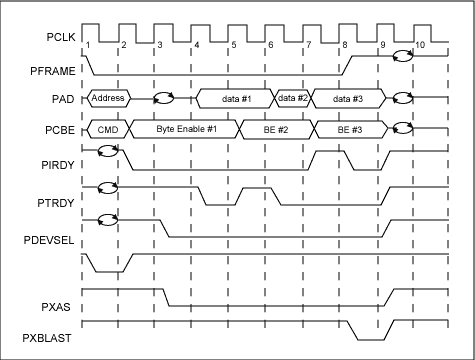
图1. DS31256 PCI总线读
访问类型2:DMA突发写主机RAM
当DMA突发写主机RAM时所需的总线周期总数为[2+R+D]。这可从图2和表3得到。
表3. DMA写所需的总线周期总数
| Cycle |
No. Cycles Required |
| Address Cycle |
1 |
| RAM Access Latency Cycle |
R |
| Data Cycle |
D |
| Turnaround Cycle |
1 |
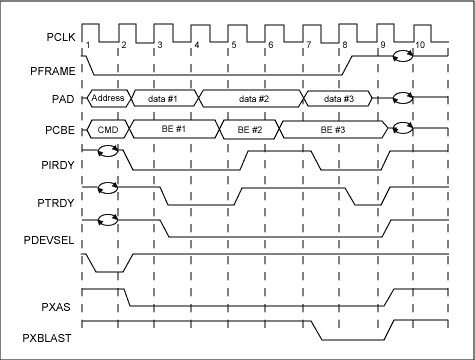
图2. DS31256 PCI总线写周期
访问类型3:主机写DS31256
主机写入DS31256时所需的总线周期总数为7。
访问类型4:主机读DS31256
主机读取DS31256时所需的总线周期总数为7。
注意:对于访问类型3和4,7个访问周期是DS31256所固有的,不能改变。
每个包所需的总线周期数
为计算总线利用率,首先必须知道所需要的总线周期数。为得到该数据,我们做了一些假设列于表4。图3给出了在收到或发出一个数据包时主机和DMA将要执行的标准流程。根据图3,我们有可能得出一个公式,来计算每个包所需要的平均总线周期数,即变量C。
发送侧
发送侧周期 = 读等待队列 + 写水平描述符链 + 读描述符 + 从主机存储器读取包 + 写完成队列 + 读/写
寄存器。
Ct = [(3 + R + 12)/12] + [2 + R + 1] + [3 + R + 4] + [(P/4) + (3 + R)X] + [(2 + R + 6)/6] + [4(7/B)]
接收侧
接收侧周期 = 读自由队列 + 将包写入主机存储器 + 写描述符 + 写完成队列 + 读/写寄存器。
Cr = [(3 + R + 24)/12] + [(P/4) + (2 + R)X] + [2 + R + 3] + [(2 + R + 6)/6] + [4(7/B)]
总公式
Ct + Cr = 21.16 + 3.5R + 0.5P + (5 + 2R)X + 56/B
表4. 为了便于计算每个包所需总线周期数所作的假设
| 1 |
All packets are 64 bytes (seen as worst case). |
| 2 |
The Frame Check Sequence (FCS) of the HDLC packet is not transferred to, or from the PCI bus. |
| 3 |
On the receive side, only large buffers are used (small buffers are disabled). |
| 4 |
The receive DMA will burst read the free queue and burst write the done queue. |
| 5 |
The transmit DMA will burst read the pending queue and burst write the done queue. |
| 6 |
All packets fit within a single buffer (i.e., only one descriptor). This is reasonable because packets are 64 bytes. |
| 7 |
All physical layer links are filled with packets; no idle codes are sent or received. |
| 8 |
Interrupt routines and overhead (like accesses to the local bus) are not considered. |
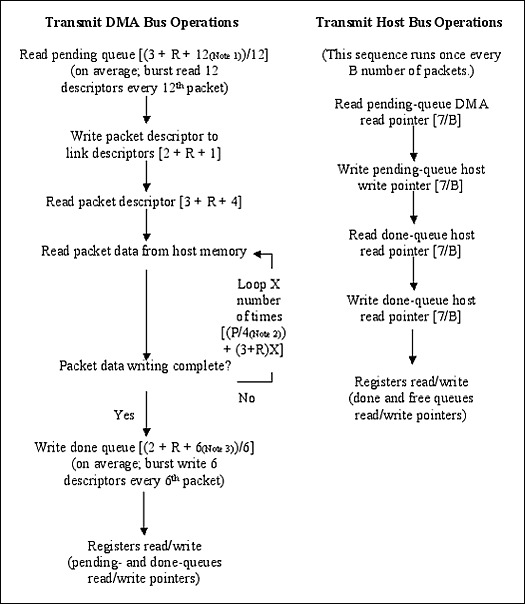
图3. 每个包的总线处理流程
注:
- 12个描述符 x 1双字 = 12个发送等待队列描述符双字
- 包数据字节数 = 4字节/数据周期
- 6个描述符 x 1双字 = 6个发送完成队列描述符双字
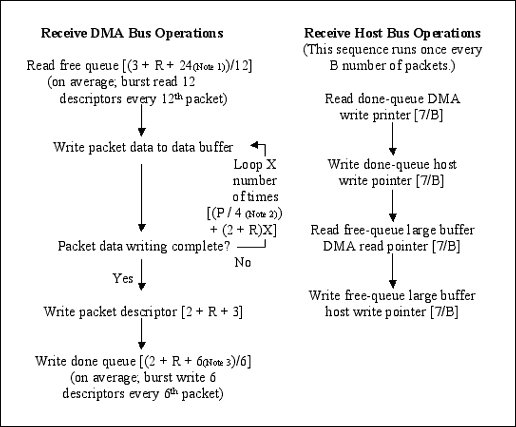
图3. (续)
注:
- 12个描述符 x 2双字 = 24个接收自由队列描述符双字
- 包数据字节数 = 4字节/数据周期
- 6个描述符 x 1双字 = 6个接收完成队列描述符双字
PCI总线利用率
总线利用率定义为DS31256每秒所需的总线周期数除以每秒可供使用的总线周期总数。总线利用率可按照特定的HDLC配置和业务量计算。计算中假定PCI总线时钟速率为33MHz (33,000,000Hz),并且只用一片DS31256。以下就是PCI总线利用率的详细计算方法。
公式1:

公式2:

注:
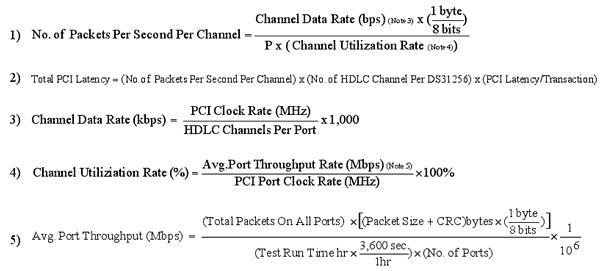
举例
有关PCI总线利用率的实验室测量结果展示了DS31256的PCI总线使用情况。其中假定所有收到的和发出的数据包都为56字节长(P = 56)。结果归纳于表5。我们还制作了一个可以计算总线利用率的速算表(如表6所示),如果需要可以索要(请联络
telecom.support@
maxim-
ic.com (English only)。)
表5. PCI总线利用率实验室实测数据
| |
|
B |
P |
R |
|
|
|
|
|
| Mode |
No. of Ports |
Avg. No. Done Queues Entries Processed |
Pkt Size (Bytes) |
Avg. RAM Access Latency Cycles |
No. of HDLC Channels |
Total No. of Channels |
Channel Data Rate (kbps) |
PCI Clock Rate (MHz) |
PCI Bus Util.(%) |
| High Speed |
3 |
14.17 |
56 |
8.35 |
1 |
3 |
52 |
52 |
47.55 |
| Unchannelized |
3 |
35.53 |
56 |
8.50 |
1 |
3 |
29 |
29 |
49.06 |
| Low Speed |
16 |
100.46 |
56 |
10.60 |
1 |
16 |
12 |
12 |
55.27 |
| Unchannelized |
16 |
24.30 |
56 |
10.24 |
1 |
16 |
10 |
10 |
52.54 |
| T1 |
16 |
8.081 |
56 |
7.1375 |
12 |
192 |
128 * |
1.544 |
18.26 |
| E1 |
16 |
8.154 |
56 |
7.8645 |
16 |
256 |
128 |
2.048 |
28.07 |
| 2E1 |
16 |
10.894 |
56 |
8.003 |
16 |
256 |
256 |
4.096 |
55.82 |
| 4E1 |
16 |
381.207 |
56 |
8.3123 |
8 |
128 |
1024 |
8.192 |
50.97 |
* 注:
- 每个T1帧有193位 = [(24时隙 x 8位) + 1个同步位]
- 每个时隙的数据速率为64,000位/秒
- (64,000位/秒)/8位 = 8,000帧/秒
- 每125微妙到达一个T1帧 = 1/(8,000帧)/秒
- 数据速率为1,536,000位/秒 = 24信道 x (8位/信道/帧) x (8,000帧/秒)
- 线路总速率为1,544,000位/秒 = [(24信道 x (8位/信道)) + (1同步(位/帧))] x (8,000帧/秒)
表6. DS31256 PCI总线利用率速算表
| Input Variables |
|
|
| B |
14.17 |
The average number of packets processed before the host updates the Receive Free Queue and Transmit Pending Queue, or reads the Receive/Transmit Done Queues. |
| P |
56 |
The size of the packet in bytes. |
| R |
8.35 |
The average number of bus cycles added due to latency in RAM access. |
| Number of HDLC channels per DS31256 |
3 |
Use 1 per active port when operating in unchannelized mode. |
| Channel Data Rate (kbps) |
52,000.00 |
Note that T1 speed == 1536kbps. |
| Channel Utilization Rate |
39.5% |
There can be time between packets in real applications. |
| PCI Clock Rate (MHz) |
33 |
|
| PCI Latency/Transaction |
10 |
This is based on the average number of cycles required to perform each of the transactions associated with processing a packet. Our designers use 10 in their simulations, which is fairly conservative. |
| Number of DS31256's on Bus |
1 |
|
| Intermediate Variables |
|
|
| C |
104.04 |
The average number of bus cycles required per packet. |
| X |
1.00 |
The average number of bus accesses required to send/obtain packet data to/from the data buffers. |
| Packets/second/channel |
45,871.43 |
|
| Total PCI Latency |
1,376,142.86 |
|
| No. of Bus cycles required/sec |
15,693,122 |
|
| Half Duplex |
|
Full Duplex |
| Bus utilization |
47.6% |
95.11% |
| Bus Capacity (Mbps) |
264 |
|
| Bus Throughput (Mbps) |
125.54 |
251.09 |
注:

其中,1024 blocks是FIFO的尺寸,FIFO的高、低水印被设置于50%。
结束语
本应用笔记解释了如何计算在给定应用中,DS31256对于总线带宽的要求。提供了一些实验室测试的实例。并提供了一个可执行这种计算的
电子速算表,如果需要可以索取。



 关注微信
关注微信