Abstract: This appl
ica
tion no
te shows how to configure the Interleaved Bus Operation (IBO) with the DS21FF44 frame
rs by using the DS31256 HDLC controller onto a PCI bus. Other Dallas Semiconductor framers and transceivers will be used as well.
Overview
This application note describes how to configure an E1 framer f
or Interleaved Bus Operation (IBO). Interleaved Bus Operation (IBO) is designed for multiplexing data stre
ams from numerous devices onto a single bus. The DS21FF44 framers will be used with a DS31256 HDLC controller onto a PCI bus (Figure 1). Other
Maxim/Dallas Semiconductor T1/E1 framers and transceivers will also be featured. The hardware connections will be identical on a T1 framer.
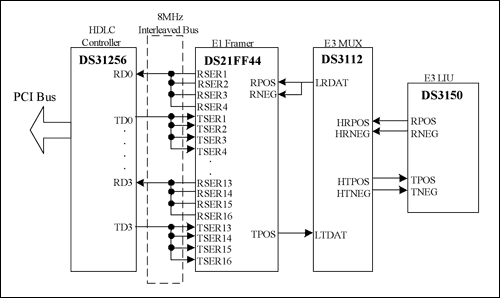
Figure 1. Example of an 8.192MHz interleaved bus in byte mode.
Hardware
Figure 2 illustrates a normal configuration of hardware connections. If the application requires frame interleaving, then TCLK and RCLK must be frequency-locked to TSYSCLK and RSYSCLK (i.e., frame slips
cannot occur). Frame slips are
acceptable in byte-interleaved applications. Also, RSYNC and
TSSYNC must be tied together. (In IBO mode the receiver is not independent of the transmitter.)
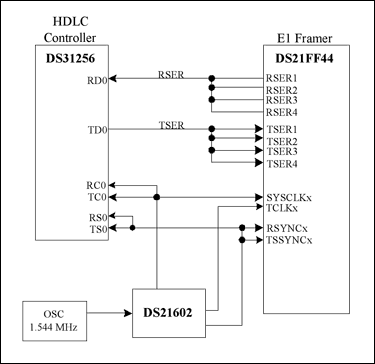
Figure 2. Connections for IBO mode.
The sync pulse must be phase-locked to the 8.192MHz clock, as shown in Figure 3. The hardware for a T1 framer differs only in the use of a 1.544MHz clock to connect to TCLK/RCLK inste
ad of an E1 frequency clock. Furthermore, in T1 every fourth channel is unused and forced to 0xFF. Consult the IBO section in the T1 data sheet for det
ails.
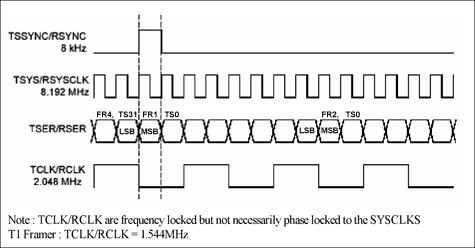
Figure 3. Timing diag
rams for IBO mode.
Refer to Section 22 of the DS21FF44 data sheet for additional timing diagrams. More information about the IBO can be found in Section 20 of the data sheet.
Software
The chip must be configured for IBO functionality. Configuration includes the setting the IBO registers, enabling the elastic stores, and configuring TSYNC and RSYNC correctly. (See the detai
led register listing in the Table 1 below.) Additionally, users must select the 2.048MHz mode for the system clocks (for both T1 and E1 framers).
Table 1. The Bits That Must Be Set on All 16 Framers
DS21FF42/FT42
DS21Q44
DS21354/554
Registers |
DS21352/552
DS21Q42
Registers |
Comment |
| RCR1.5 = 1 |
RCR2.3 = 1 |
RSYNC is an input. |
| RCR2.1 = 1 |
CCR1.2 = 1 |
Receive elastic store is enabled. |
| RCR2.2 = 1 |
CCR1.3 = 1 |
RSYSCLK is 2.048/4.096/8.192 MHz. |
| TCR1.0 = 1 |
TCR2.2 = 1 |
TSYNC is an output. |
| CCR3.1 = 1 |
CCR1.4 = 1 |
TSYSCLK is 2.048/4.096/8.192 MHz. |
| CCR3.7 = 1 |
CCR1.7 = 1 |
Transmit elastic store is enabled. |
| IBO = 0x09 |
IBO = 0x09 |
IBO enabled, byte mode, master devices (framers 1, 5, 9, 13) |
| IBO = 0x08 |
IBO = 0x08 |
IBO enabled, byte mode, slave devices (framers 2-4, 6-8, 10-12, 14-16) |
Conclusion
This application note has shown how to configure a DS21FF44 for Interleaved Bus Operation (IBO) with various Dallas Semiconductor HDLC controller, E1 framer, and transceiver devices.
If you have further questions about our framers, transceivers or HDLC controller products, please contact the Telecommunication Applications support team by email at:
telecom.support@dalsemi.com or call 01-972-371-6555.



 关注微信
关注微信