
时间:2010-05-14 08:42
人气:
作者:admin
LEDs allow new remote-controlled lighting applications
One benefit LEDs offer in general lighting applications is that they are easier to control remotely. This application note describes a remote-controlled architectural or street-lighting system and describes how to implement power-line or wireless communications control of a lighting system.
LEDs offer more design flexibility for dimming and changing the light color, which makes them ideal for applications like architectural lighting, indoor ambient lighting, and dimmable, energy-efficient street and outdoor lighting where the light is controlled remotely.
These new solutions bring great value to the customer, but for them to be successful in the marketplace, the cost of upgrading the lighting infrastructure to new LED technology must be minimized. Not surprising, solutions that can reuse the present infrastructure will likely be the first to penetrate the market.
When converting to remote-controlled LED lighting, the most costly infrastructure upgrade to anticipate is the wiring to control the LED lights. Fortunately, two technologies can negate the need for that costly upgrade: LED lamps can be controlled with a wireless link, or they can be controlled through existing power lines using PLC technology.
PLC technology allows communication over a long range, but this can be problematic when breakers or transformers on the AC line do not allow the communication to flow freely. While wireless communications do not have this problem, the wireless communication range can be limited if free bands are used. A mix of both technologies can sometimes be the best solution: powerline connections for devices that are not separated by transformers, and wireless connections to bypass transformers.
The main design requirements for remote-controlled LED lighting solutions are:
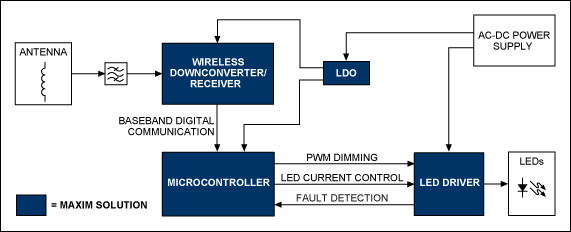
Block diagram of a typical wireless-controlled lighting system.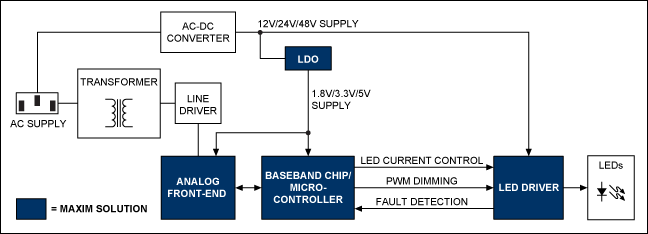
Block diagram of a typical PLC-controlled lighting system.
A remote-controlled lamp often includes a microcontroller, either as a discrete component or integrated in another IC. Unless a complex communication protocol is adopted with a complex stack (e.g., ZigBee®), a basic microcontroller is typically sufficient. The microcontroller's duties will typically include decoding of the communication protocol, generation of dimming signals for the LED driver, reading faults, and controlling the lighting effects of the lamp, (e.g., theater dimming).
For wireless communication in lighting applications, Maxim offers the MAX1473 receiver and the MAX1472 transmitter. These products allow communication in the 300MHz to 450MHz free bands, over a range of 30m to 50m in an indoor environment. The MAXQ610 microcontroller offers all the required features at a low cost.
For PLC, Maxim's solution includes the MAX2991 analog front-end (AFE) and the MAX2990 baseband processor. These devices form a powerline transmitter/receiver chipset that is capable of transmitting data over distances up to 10km and at data rates up to 100kbps. This range makes the parts ideal for street-lighting applications. A microcontroller with PWM outputs to control the PWM dimming input of the LED driver is integrated into the MAX2990. This feature eliminates the need for another circuit to generate this signal.

 关注微信
关注微信