How to Switch the DisplayPort Hot-Plug-Detect Signal with the MAX4928
Abstract: The MAX4928A/B are DisplayPort™ switches normally used to steer signals between PCIe® and DisplayPort sources. The HPD (hot-plug-detect) signal coming from a DisplayPort monitor or DisplayPort panel is not compatible with either the controller hub or the MAX4928 switch. This application note explains that most DisplayPort switches have voltage level maxima that should not be exceeded and that a simple resistive divider cannot be used to meet logic levels for every application. The article presents a simple solution which adds a digital transistor as a logic-level shifter from LV-TTL to ~1V logic.
Introduction
The HPD (hot-plug-detect) signal available from a DisplayPort¹ monitor (i.e., a sink) is an LV-TTL level signal. Input low is VIL ≤ 0.8V and input high is 2.4V ≤ VIH ≤ 3.6V. However, these levels do not match many of the devices which the DisplayPort needs to control. Design solutions are needed to shift the logic levels for some applications.
Using a Digital Transistor as a Logic-Level Shifter
The MAX4928A/B DisplayPort switches are normally used to steer signals between PCIe and DisplayPort sources. Most switches in this category have voltage-level maxima that should not be exceeded, in this case VSIG ≤ +2.0V. The DisplayPort source is usually a controller hub operating from a supply of +1.1V. The logic level for this device is VIL ≤ 0.2V, and VIH ≤ 0.9V. It is, moreover, not possible to use a simple resistive divider and meet logic levels for all applications.
The simplest solution is to add a digital transistor, a device available in several p
ackages that include two resistors and one transistor. Figure 1 illustrates the use of a digital transistor acting as a logic-level shifter from LV-TTL to ~1V logic.
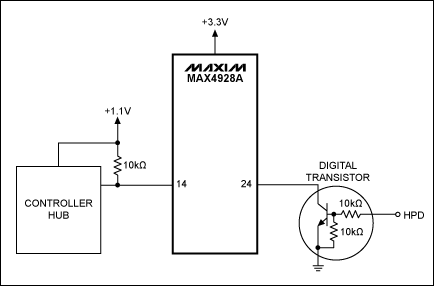
Figure 1. A digital transistor between the MAX4928 DisplayPort switch and hot-plug-detect signal acts as a logic-level shifter from LV-TTL to ~1V logic.
In Figure 1 the digital transistor takes in the LV-TTL logic. The transistor is also logic-level compatible with the controller hub because of its pullup resistor to the same supply. Digital transistors are available in packages 2.0mm x 2.0mm or smaller from several discrete semiconductor vendors. It is important to remember that with this design the logic is now inverted; a logic-level low asserts a hot-plug event.
The MAX4928 can also be used to switch either the DisplayPort port from a controller hub or an MXM² (Mobile PCI Express) module. The MAX4928's HPD port is logic-level compatible with the DisplayPort port. While this seems to make sense, the HPD cannot be run through the switch and remain compatible with both the controller hub and the MXM module without some help. Once again, a digital transistor will solve the problem, and fortunately, it is available as two complete devices in a single package. Figure 2 shows the complete schematic.
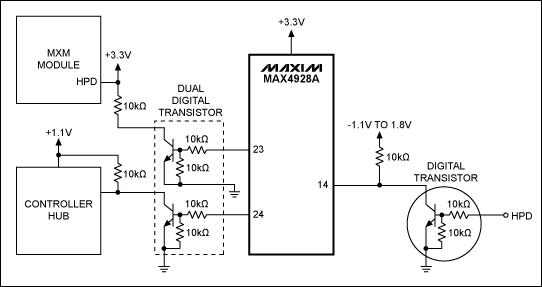
Figure 2. The MAX4928 is used to switch either the DisplayPort port from a controller hub or an MXM² module.
With dual digital transisto
rs, the first is used to invert the logic and reduce its level; the second device inverts the logic once again, but changes its logic level to be 1.1V compatible. A third digital transistor pe
rforms the same function for the MXM module, but is pul
led up to 3.3V to be compatible with MXM. In this latter case the logic is asserted high when HPD is high and matches the MXM module. The user just needs to make sure that this is the logic expected in the software for the controller hub.
Conclusion
A digital transistor is very useful when used with HPD signals. The HPD signal coming from a DisplayPort monitor or DisplayPort panel is not compatible with either the controller hub or the MAX4928 switch. By using a digital transistor ahead of the switch and a dual-digital transistor after the switch, the circuit is logic-level compatible with the controller hub and the MXM module and uses very few parts. The design occu
pies very little space and is very low cost.
References:
- DisplayPort is a standard under VESA for connecting LCD panels and various monitors to a computer.
- MXM is an add-in graphics module for laptop PCs.
DisplayPort is a trademark of Video Electronics Standards Association.
PCI Express is a registered trademark of PCI-SIG Corp.
PCIe is a registered trademark of PCI-SIG Corp.


 关注微信
关注微信