Abstract: The MAX4450 opera
tional amplifier configured in a 3-pole, low-pass Sallen-Key fil
ter provides a Butterw
orth response with a bandwidth of -3dB at 5.25MHz. This circuit
can be used for video anti-aliasing and reconstruction filtering for composite (CVBS) or S-Video signals in standard definition digital TV (
SDTV) appl
ications. The circuit is designed to drive a 75Ω termination, common in video applications, with an overall g
ain of 1.
This application note describes a 5.25MHz, 3-Pole, Butterworth filter using a Sallen-Key realization. It has gain of 2V/V, for driving a 75Ω b
ack-terminated coax to an overall gain of 1. Such filte
rs are used for video reconstruction of RGB and component video (Y, Pb, Pr) signals following a
DAC to remove the higher frequency replicas of the signal, and as an anti-aliasing filter before an
ADC.
The circuit shown in Figure 1 uses a single MAX4450 op-amp. The insertion loss is >20db at 13.5MHz, and >40db at 27MHz.
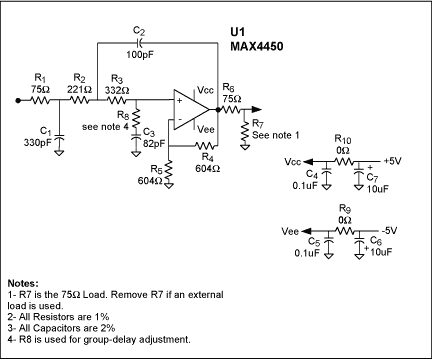
Figure 1. A 5MHz, 3-Pole, Butterworth active filter—using a Sallen-Key realization—with
adjustable group delay.
To preserve the quality of the video waveform, it's important that the filter's group-delay variation, and the group-delay differential between filters, be as low as possible. Some means of adjusting group delay without affecting bandwidth is required. The addition of R8 in series with C3 and R3 creates a lag-lead network. By keeping the sum of R3 and R8 constant and equal to the original R3 value, the dominant-pole frequency isn't affected, preserving the bandwidth, but as the value of R3 increases, a "lead" term is introduced, reducing the rate of change of the phase, and consequentially, the group delay.
In the circuit shown, the average group-delay variation ac
ross the filter's bandwidth for R8 = 0Ω and R3 = 332Ω is about 25nsec. Raising R8 to 31.6Ω and lowering R3 to 301Ω drops the group-delay variation to about 15nsec, and to 7nsec for and R8 = 59Ω and R3 = 274Ω. This slightly affects the band-edge selectivity, <0.5dB; but the -3dB bandwidth remains unchanged, as shown in Figure 2.
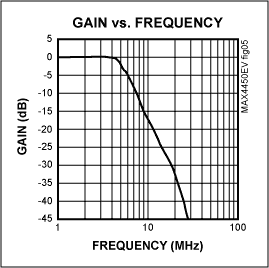
Figure 2. Gain vs. frequency of the filter.



 关注微信
关注微信