Abstract: This reference design f
or the MAX2160 tuner plus demodulator
IC demonstra
tes a compact daughter-board solu
tion for the I
SDB-T standard (single-segment). This design converts UHF band signals (470MHz to 770MHz) to a MPEG-2 transport stream. The solution is intended for portable applications, such as cell-phone
TVs and PDAs.
Figure 1. The reference design for the MAX2160 tuner plus demodulator. 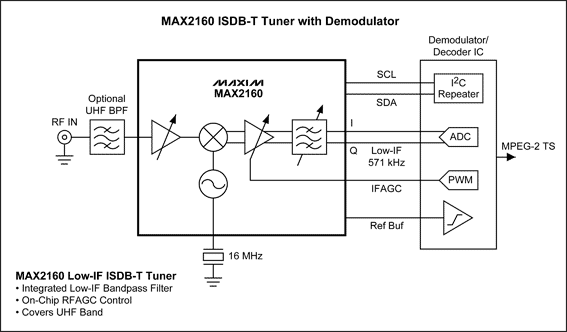 Figure 2. System block diagram.
 Figure 3. Sensitivity measures better than -97dBm. The tradeoff in sensitivity is also shown when an optional WCDMA or cdma2000® rejection filter is added at the RF input.
 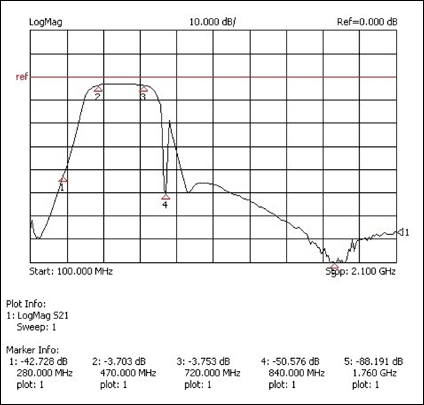 Figure 4. A WCDMA blocker rejection filter response. To implement on-board coexistence of ISDB-T with a WCDMA system, additional input filtering is required to reject the cellular transmit-band frequencies. The optional reference-design filtering is a combination of two filters, which provide approximately 47dB of attenuation at the cellular transmit band (marker 4).
  Figure 5. CDMA-2000 blocker rejection filter response. To implement on-board coexistence of ISDB-T with a cdma2000 system in a handheld application, additional input filtering is required to reject the cellular transmit-band frequencies. The optional reference-design filter provides approximately 42dB of attenuation at cdma2000 transmit frequencies (marker 4).
| Parameter |
Conditions |
Target |
Measured |
Units |
| Maximum Input |
UHF: Ch. 13, Ch. 33, Ch. 52 |
0 |
8.9, 8.2, 7.3 |
dBm |
Adjacent Channel Selectivity
(Desired: -70dBm) |
UHF: Ch. 13, Ch. 33, Ch. 52 |
35 |
45, 47, 45 |
dBc |
| WCDMA Blocker Performance |
UHF: Ch. 13, Ch. 33, Ch. 52 |
24 |
23.5, 24, 24 |
dBm |
| cdma2000 Blocker Performance |
UHF: Ch. 13, Ch. 33, Ch. 52 |
10 |
21, 21, 21 |
dBm | | |
 Figure 6. The ISDB-T RF signal is broadcast in the UHF band, as shown above. The channel spacing is 6MHz.
The MAX2160/MAX2160EGB tuner ICs are designed for use in Japanese mobile digital-TV (ISDB-T single-segment) applications. The devices directly convert UHF band signals to a low-IF by using a broadband I/Q downconverter. The operating frequency range extends from 470MHz to 770MHz.
The MAX2160/MAX2160EBG support both I/Q low-IF interfaces and single low-IF interfaces. The devices are thus universal tuners for various digital demodulator implementations.
The MAX2160/MAX2160EBG integrate LNA, RF and low-IF variable-gain amplifiers (VGAs), I and Q downconverting mixers, and bandpass filters providing in excess of 42dB of image rejection. The parts operate with either high-side or low-side local oscillator (LO) injection. The devices' VGAs provide in excess of 100dB of gain-control range.
The MAX2160/MAX2160EBG also have fully monolithic VCOs and tank circuits, and a complete frequency synthesizer. A XTAL oscillator and separate TCXO input buffer are also included. The devices operate with XTAL/TCXO oscillators from 13MHz to 26MHz, which enable the shared use of a VC-TCXO in cellular handset applications. Additionally, a divider is provided for the XTAL/TCXO oscillator, thus allowing for a
simple and low-cost interface to various channel decoders.
cdma2000 is a registered trademark of Telecommunications Industry Association.


 关注微信
关注微信