
时间:2022-03-10 13:37
人气:
作者:admin
virtio 是一种通用的半虚拟化的 I/O 通信协议,提供了一套前后端 I/O 通信的的框架协议和编程接口。根据该协议实现的设备通过前后端的配合,相比全模拟设备可以大幅减少陷入陷出以及内存拷贝的次数,使 guest 获得高效的 I/O 性能。作为目前虚拟化标准的通用协议规范,经历了 0.95、1.0、1.1 三个版本的演进。根据 0.95 版本实现的称为传统 virtio 设备,1.0 版本修改了一些 PCI 配置空间的访问方式和 virtioqueue 的优化和特定设备的约定,1.1 版本则增加了 packed virtqueue 的支持,详细可以参考官方发布的 virtio 协议规范。
之所以称 virtio 是一种半虚拟化的解决方案,是因为其首先需要在主机侧通过软件创建 virito 的后端设备,其次在 Guest 要有对应的设备前端驱动,前后端通过共享内存进行通信。virtio 规范定义了设备的控制和数据面接口,控制面接口包括设备状态、feature 的协商等,数据面则包括共享内存的数据布局定义以及前后端的通知方式。基于 virtio 协议,目前已衍生出了 virtio-blk、virtio-net、virtio-scsi、virtio-mem 等各种各样的半虚拟化设备。virtio 设备可以支持多种传输层协议,既可以挂载到 MMIO 总线,也可以作为 PCI 设备,另外还可以支持基于标准 I/O 通道机制的 S/390 设备。
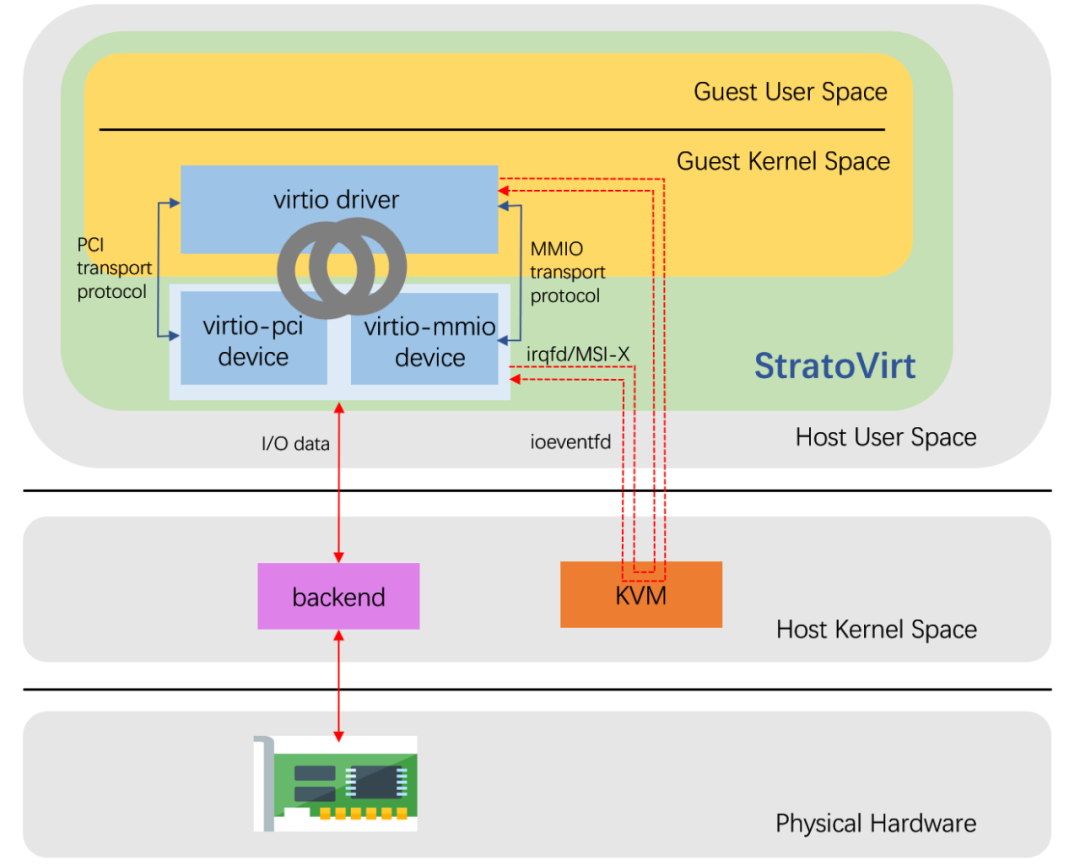
鉴于 virtio 设备具备较好的性能及通用性,StratoVirt 自然也支持,StratoVirt 中 virtio 设备的实现架构以及 I/O 通信流程如上图所示。下面就基于目前最新的代码,探究一下 StratoVirt 中 virtio 设备的代码实现框架。
StratoVirt 的 virtio crate 提供了 virtio 设备的通用接口以及所有 virtio 设备的相关实现。其中,lib.rs 中定义了为所有 virtio 设备定义的 VirtioDevice Trait。每种 virtio 设备都需要实现自定义的 VirtioDevice 接口。
///Thetraitforvirtiodeviceoperations.
pubtraitVirtioDevice:Send{
///Realizelowleveldevice.
fnrealize(&mutself)->Result<()>;

///Unrealizelowleveldevice
fnunrealize(&mutself)->Result<()>{
bail!("Unrealizeofthevirtiodeviceisnotimplemented");
}

///Getthevirtiodevicetype,refertoVirtioSpec.
fndevice_type(&self)->u32;

///Getthecountofvirtiodevicequeues.
fnqueue_num(&self)->usize;

///Getthequeuesizeofvirtiodevice.
fnqueue_size(&self)->u16;

///Getdevicefeaturesfromhost.
fnget_device_features(&self,features_select:u32)->u32;

///Setdriverfeaturesbyguest.
fnset_driver_features(&mutself,page:u32,value:u32);

///Readdataofconfigfromguest.
fnread_config(&self,offset:u64,data:&mut[u8])->Result<()>;

///Writedatatoconfigfromguest.
fnwrite_config(&mutself,offset:u64,data:&[u8])->Result<()>;

///Activatethevirtiodevice,thisfunctioniscalledbyvcputhreadwhenfrontend
///virtiodriverisreadyandwrite`DRIVER_OK`tobackend.
///
///#Arguments
///
///*`mem_space`-Systemmem.
///*`interrupt_evt`-Theeventfdusedtosendinterrupttoguest.
///*`interrupt_status`-Theinterruptstatuspresenttoguest.
///*`queues`-Thevirtioqueues.
///*`queue_evts`-Thenotifiereventsfromguest.
fnactivate(
&mutself,
mem_space:Arc,
interrupt_cb:Arc,
queues:&[Arc>],
queue_evts:Vec,
)->Result<()>;

///Deactivatevirtiodevice,thisfunctionremoveeventfd
///ofdeviceoutoftheeventloop.
fndeactivate(&mutself)->Result<()>{
bail!(
"Resetthisdeviceisnotsupported,virtiodevtypeis{}",
self.device_type()
);
}

///Resetvirtiodevice.
fnreset(&mutself)->Result<()>{
Ok(())
}

///UpdatethelowlevelconfigofMMIOdevice,
///forexample:updatetheimagesfilefdofvirtioblockdevice.
///
///#Arguments
///
///*`_file_path`-Therelatedbackendfilepath.
fnupdate_config(&mutself,_dev_config:OptiondynConfigCheck>>)->Result<()>{
bail!("Unsupportedtoupdateconfiguration")
}
}
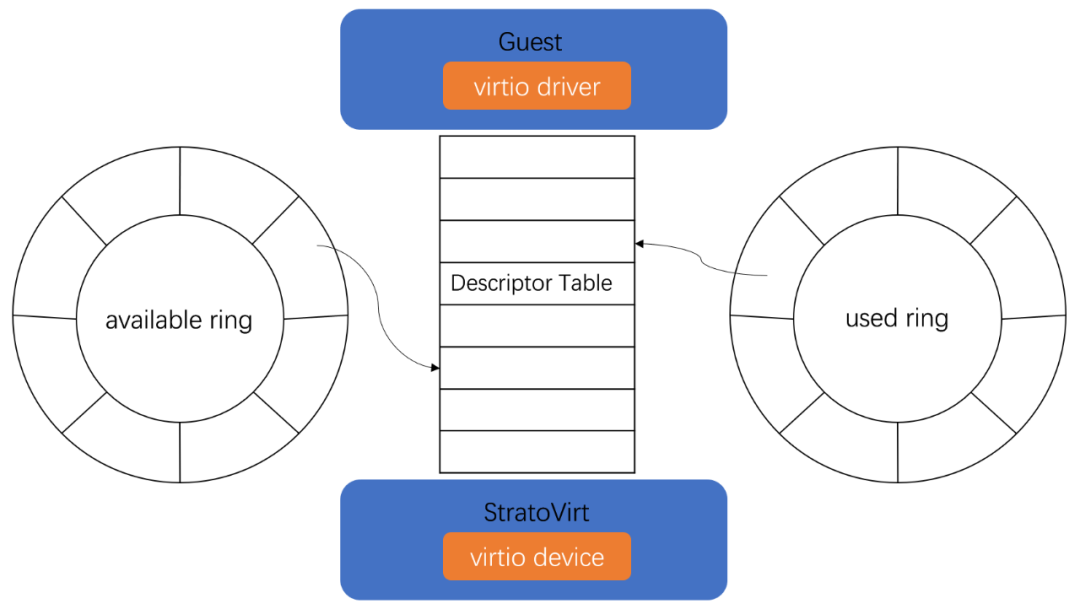
virtio 设备可以有一个或多个队列,每个队列有描述符表、available ring、used ring 三个部分。当前 StratoVirt 的 virtio 设备均遵循 1.0 规范,队列的内存布局仅支持 Split Vring 的方式。queue.rs 中定义了一系列针对队列操作及查询的接口。所有的 I/O 请求数据信息以描述符的形式存放在描述符表中,前端准备好数据后更新 available ring 告诉后端还有哪些 I/O 待发送,后端执行完 I/O 更新 used ring 通知前端。不同设备的 I/O 处理不尽相同,但是核心的 virtqueue 操作是一样的。
pubstructSplitVring{
///Regioncacheinformation.
pubcache:Option,
///Guestphysicaladdressofthedescriptortable.
///Thetableiscomposedofdescriptors(SplitVringDesc).
pubdesc_table:GuestAddress,

///Guestphysicaladdressoftheavailablering.
///Theringiscomposedofflags(u16),idx(u16),ring[size](u16)andused_event(u16).
pubavail_ring:GuestAddress,

///Guestphysicaladdressoftheusedring.
///Theringiscomposedofflags(u16),idx(u16),used_ring[size](UsedElem)andavail_event(u16).
pubused_ring:GuestAddress,

///Hostaddresscache.
pubaddr_cache:VirtioAddrCache,

///Indicatewhetherthequeueconfigurationisfinished.
pubready:bool,

///Themaximalsizeinelementsofferedbythedevice.
pubmax_size:u16,

///Thequeuesizesetbyfrontend.
pubsize:u16,

///Interruptvectorindexofthequeueformsix
pubvector:u16,

///Thenextindexwhichcanbepoppedintheavailablevring.
next_avail:Wrapping<u16>,

///Thenextindexwhichcanbepushedintheusedvring.
next_used:Wrapping<u16>,

///Theindexoflastdescriptorusedwhichhastriggeredinterrupt.
last_signal_used:Wrapping<u16>,
}
StratoVirt 目前提供两种机型:轻量机型和标准机型。轻量机型由于需要追求极致的启动速度以及内存底噪开销,因此只支持挂载数量有限的 virtio-mmio 设备。而标准机型面向传统的标准云化场景,对于 I/O 设备的性能要求较高,且需要支持热插拔满足资源弹性,因此标准机型支持将 virtio 设备以 PCI 设备挂载在模拟的 PCI 总线上。目前标准机型只支持配置 virtio-pci 设备,不支持 virtio-mmio 设备。
结构体 VirtioMmioDevice 定义了一个通用的 virtio-mmio 设备,其中的 device 即为实现了 VirtioDevice 这个 trait 的具体的 virtio 设备结构,可以是网卡、磁盘等。VirtioMmioState 结构体中存放了 virtio-mmio 设备的控制寄存器,并且为其实现了对应的读写接口 read_common_config()/write_common_config()。virtio-mmio 设备的配置空间布局如下图所示:

interrupt_evt 通过 irqfd 向虚拟机注入中断,host_notify_info 则为每个队列创建了一个 eventfd,虚拟机利用 ioeventfd 机制陷出到 StratoVirt 执行后端的 I/O 处理。
pubstructVirtioMmioDevice{
//Theentityoflowleveldevice.
pubdevice:ArcdynVirtioDevice>>,
//EventFdusedtosendinterrupttoVM
interrupt_evt:EventFd,
//Interruptstatus.
interrupt_status:Arc,
//HostNotifyInfousedforguestnotifier
host_notify_info:HostNotifyInfo,
//Thestateofvirtiommiodevice.
state:VirtioMmioState,
//Systemaddressspace.
mem_space:Arc,
//Virtioqueues.
queues:Vec>>,
//SystemResourceofdevice.
res:SysRes,
}
VirtioMmioDevice 实现了 realize 接口完成设备的具现化:
pubfnrealize(
mutself,
sysbus:&mutSysBus,
region_base:u64,
region_size:u64,
#[cfg(target_arch="x86_64")]bs:&Arc>,
)->ResultSelf>>>{
self.device
.lock()
.unwrap()
.realize()
.chain_err(||"Failedtorealizevirtio.")?;

ifregion_base>=sysbus.mmio_region.1{
bail!("Mmioregionspaceexhausted.");
}
self.set_sys_resource(sysbus,region_base,region_size)?;
letdev=Arc::new(self));
sysbus.attach_device(&dev,region_base,region_size)?;

#[cfg(target_arch="x86_64")]
bs.lock().unwrap().kernel_cmdline.push(Param{
param_type:"virtio_mmio.device".to_string(),
value:format!(
"{}@0x{:08x}:{}",
region_size,
region_base,
dev.lock().unwrap().res.irq
),
});
Ok(dev)
}
前端驱动加载过程中会读写设备的配置空间,前后端完成 feature 的协商,一切 OK 后前端驱动将向配置空间写状态,后端设备将会调用 activate 方法激活设备。当触发激活时,前端已为这三个部分分配了内存空间,Guest 物理地址(GPA)已写入设备的配置空间,后端需要将 GPA 地址转化为 Host 虚拟地址(HVA)。随后,就可以根据队列配置创建队列,并将 I/O 的 eventfd 加入事件循环激活设备开始 I/O 通信。
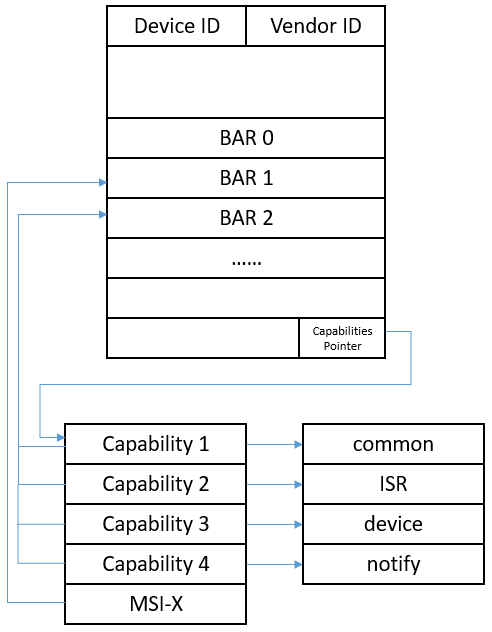
如上所述,virtio 设备也可以作为一个 PCI 类设备挂载到 PCI 总线上。类似的,在 StratoVirt 中用结构体 VirtioPciDevice 来表示一个 virtio-pci 设备。既然是作为一个 PCI 设备,virtio-pci 就需要拥有符合 PCI 规范拥有 PCI 设备的配置空间,Guest 启动后通过 PCI 设备树枚举来发现设备,而不是像 virtio-mmio 设备一样直接通过内核启动参数告诉 Guest。
pubstructVirtioPciDevice{
///Nameofthisdevice
name:String,
///Theentityofvirtiodevice
device:ArcdynVirtioDevice>>,
///Deviceid
dev_id:Arc,
///Devfn
devfn:u8,
///Ifthisdeviceisactivatedornot.
device_activated:Arc,
///MemoryAddressSpace
sys_mem:Arc,
///Pciconfigspace.
config:PciConfig,
///VirtiocommonconfigrefertoVirtioSpec.
common_config:Arc>,
///PrimaryBus
parent_bus:Weak>,
///Eventfdsusedfornotifyingtheguest.
notify_eventfds:NotifyEventFds,
///Thefunctionforinterrupttriggering
interrupt_cb:Option>,
///Virtioqueues.ThevectorandQueuewillbesharedacrossingthread,soallwithArc>wrapper.
queues:ArcVec>>>>,
///Multi-Functionflag.
multi_func:bool,
}
VirtioPciDevice 通过实现 PciDevOps trait 的 realize()方法完成设备的具现化:




 关注微信
关注微信