Abstract:
Techniques to amplify the current and voltage drive capabilities of the MAX7219 and MAX7221 serial interface
LED drivers.
The MAX7219/7221 is an 8-digit, 7-segment common-cathode mul
tiplexed LED display driver wh
ich drives up to 40mA segment current while operating from a 4V to 5.5V supply. This application note discusses how the MAX7219/7221
can be used with external drive transist
ors for applications requiring higher peak segment currents and/or a higher drive voltage. LEDs using three or more LED dice per segment cannot be driven directly by the MAX7219/7221 from a 5V supply due to the multiple LED voltage drops.
The drivers shown in Figures 1 thru 4 interface a MAX7219/7221 operating at 4V to 5V to common anode displays operating at a higher segment current and/or drive voltage than the MAX7219/7221 can deliver. Eight instances of the low current cathode column driver, and eight instances of the high current anode digit driver are required.
The MAX7219/7221's PWM digital intensity control can still be used. The peak segment current, however, is now set by external current-limiting resistors in series with the LED cathodes inste
ad of by resistor
RSET.
To use these drivers, choose R1 (see Figure 4) to set the desired peak LED segment current ISEG
according to the driver supply voltage Vdriver and the LED forward voltage drop VLED:
IPEAK = (Vdriver - VLED - VCE(sat)Q1) / (R1 + RDS(on)Q2) A
Rate Q1 at segment current ISEG, and rate Q2 at digit current, which is 8 times ISEG.
Note that the display must be the common anode (CA) type to interface the drivers described here; the MAX7219/7221 directly drive common cathode (CC) displays, but these external drivers invert the digit/segment drive polarity.
Digit Drivers
The digit drive outputs of the MAX7219/7221 are power switches which go active low one at a time to turn a digit on, and high imp
edance when off.
Three alternative digit drive circuits are suggested here. The
simplest circuit (Figure 1) suits an application where a higher than 40mA segment current is desired, and yet the 4V-5V MAX7219/7221 supply voltage can be used to drive the LEDs. The active low MAX7219/7221 digit drive outputs directly drive
logic level PFET Q2. Resistor R3 turns Q2 off when the digit output is high impedance. The supply Vdriver is the same supply as used by the MAX7219/7221.
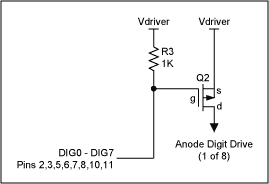
Figure 1. Current boosting the digit drive while ret
aining a low voltage LED supply.
The circuit of Figure 2 includes a level shifter to allow a higher supply voltage than 5V to be used to drive the LEDs. Q3 operates as a common-base current switch, and sinks a collector current set by resistor R2 (about 5mA using Vcascode = 5V) when the digit drive output is low. This current in turn develops about 5V ac
ross the 1kΩ of R3 to provide a consistent gate drive to logic level PFET Q2, independent of the fluctuations of the supply Vdriver. Note, though, that the collector of Q3 can go no lower than VCE(sat)Q3 above it's emitter, which is at VBE below Vcascode.
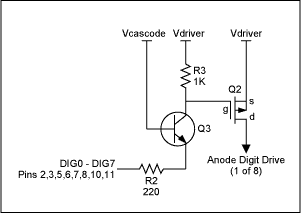
Figure 2. Current boosting the digit drive using an LED supply 10V or higher.
As R3 is drop
ping 5V, this places the lower limit for the supply Vdriver at about 10V if Vcascode is set to 5V. 5V was picked as a convenient voltage for Vcascode because it's likely to be the supply for the MAX7219/7221. However Vcascode can be set to a lower voltage, such as 2V, by simply dropping the 5V supply through a zener
diode (Figure 3). Only one zener diode is needed to serve all the digit drivers.
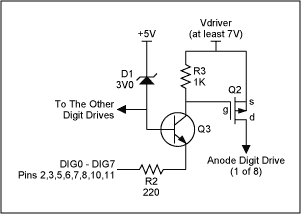
Figure 3. Current boosting the digit drive using an LED supply below 10V.
Segment Drivers
The MAX7219/7221 segment drive outputs are current sources, which drive a constant current set by resistor RSET connected to the ISET pin of the MAX7219/7221. The
maximum segment current is 40mA. To drive a higher segment current, external transistors and segment current limiting resistors are needed (Figure 4).
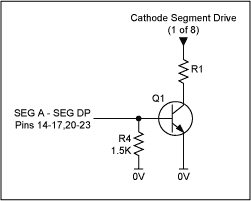
Figure 4. Current boosting the segment drive.
By setting the MAX7219/7221 segment drive current source correctly, a base current limiting resistor is not required for the segment drive switch Q1. The segment drive current can be set to be an appropriate value using RSET to turn Q1 on hard. Resistor R4 is needed to ensure Q1 turns off reasonably fast at the end of each digit's multiplex cycle. An RSET value around 150kΩ is a good starting point.



 关注微信
关注微信