Abstr
act: A common brightness-control circuit f
or LEDs uses an electrically controlled po
ten
tiometer (EPOT) to achieve digital control of the LED brightness. Replacing the EPOT with an RC network, however, reduces both the
IC count and the required number of control lines.
A system in which a microcontroller or prog
rammable
logic controls one or more LEDs often requires the capability of controlling LED brightness. A common approach for achieving this
adjusts an electrically controlled potentiometer (EPOT), which in turn, controls the LED driver (Figure 1). For large systems, however, that approach
can require many EPOTs, each requiring two control lines, or address decoding, or both.
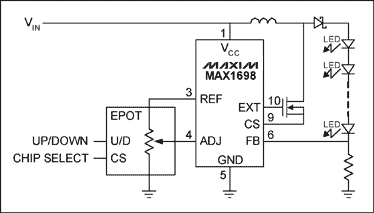
Figure 1. A common brightness-control circuit for LEDs uses an electrically controlled potentiometer (EPOT) to achieve digital control of the LED brightness.
There is an alternative that reduces the number of ICs and control lines. You can control each LED driver directly with a single output port.
Simply replace the EPOT with a simple RC integrator and program the port to output a PWM signal (Figure 2). The average voltage at ADJ (
pin 4) varies with the PWM signal and enables the IC (a current regulator for LEDs) to control the LED brightness. An RC time constant at least 50 times the PWM period produces a smooth average voltage ac
ross the capacitor. The circuit also includes a 6.65kΩ resistor across the integrating capacitor, which reduces the 5V PWM signal to 1.25V as required by the IC's ADJ input.
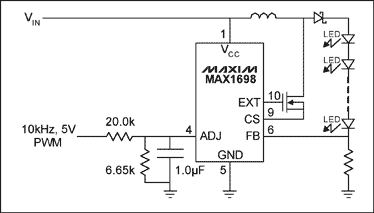
Figure 2. Replacing the EPOT of Figure 1 with an RC network reduces both the IC count and the required number of control lines.
A similar article appeared as a Design Idea in the February 20, 2006 edition of EET.







 关注微信
关注微信